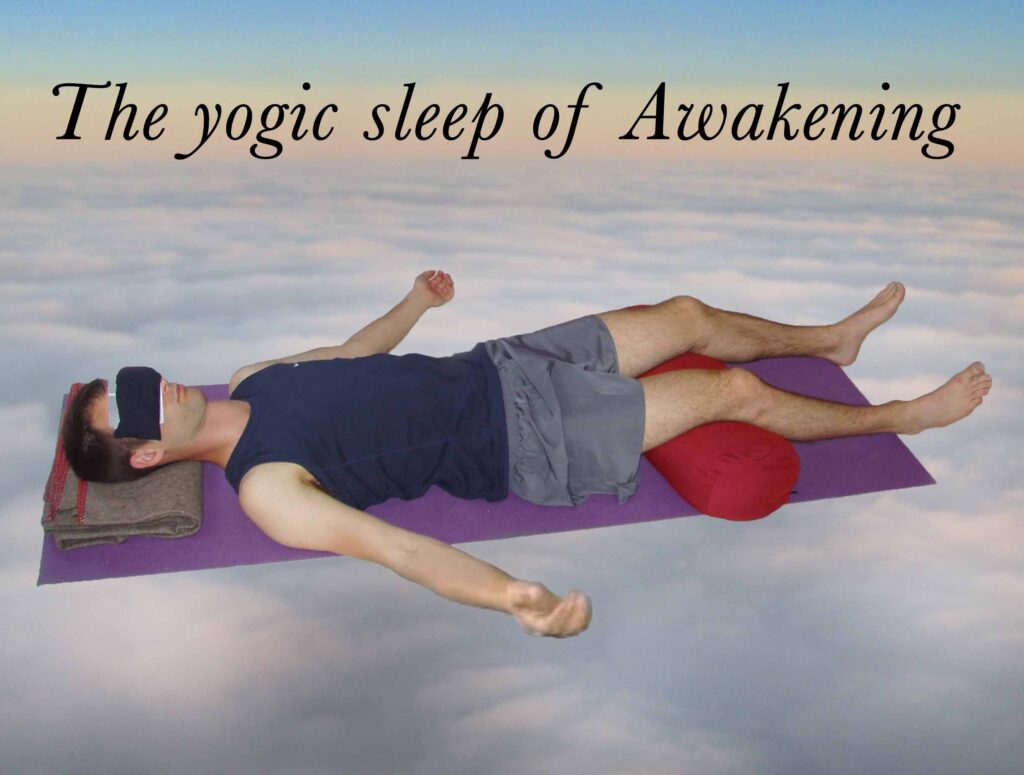
Imagine lying down, being gently guided, and letting your body and mind completely let go, without falling asleep and without wondering if you are “doing it right.” That’s yoga nidra.
Experience yoga nidra live online from the comfort of your own home Wednesday evenings 19.30-20.30 UK time.
What exactly is yoga nidra?
Yoga nidra is often called “yogic sleep,” but it isn’t actually sleep. In the nidra state you stay conscious and aware while your body softens into deep relaxation and your mind detaches from its constant chatter. It’s a liminal place between waking and sleeping, which modern neuroscientists call Non-Sleep Deep Rest (NSDR)
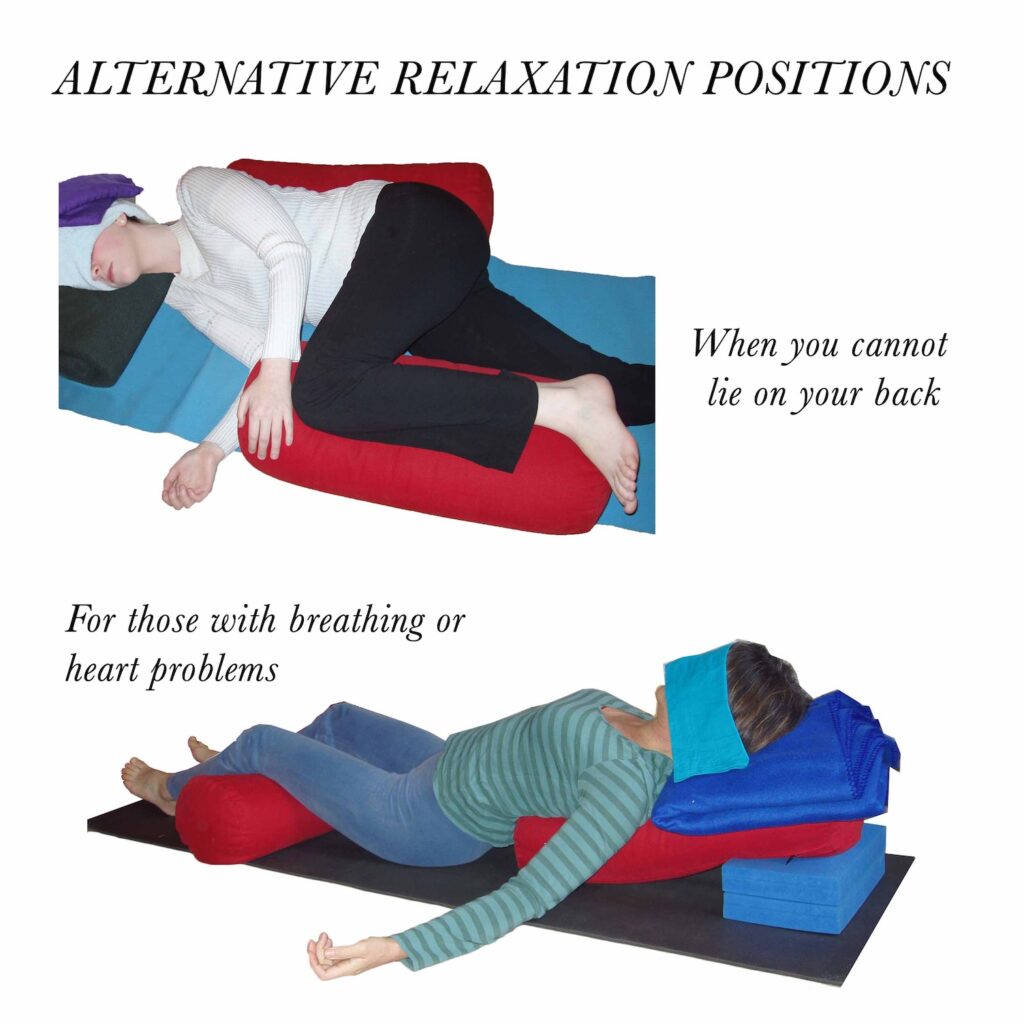
You’re guided effortlessly into a meditative relaxation while lying comfortably on your back. That makes it ideal if you’ve struggled with sitting meditation, a busy mind, aches and pains, or fidgeting. There’s no technique to master and nothing to get wrong. Other possible relaxation positions are shown below or, if you prefer, it can also be practised sitting upright.
A journey through the five levels of being
Traditional yoga nidra takes you through eight stages of awareness, exploring the koshas, the layers of being
• Body
• Breath
• Mind
• Intuitive wisdom
• Spirit or consciousness
As you bring awareness to each layer, you begin to see them as the changing content of your experience, and yourself as the vast, unchanging awareness that holds it all. At the same time, you direct the light of consciousness and healing energy (prana) into every part of yourself. It’s one of the most deeply restorative and liberating practices in yoga.
Your heartfelt wish
A signature feature of yoga nidra is the Sankalpa: a short, positive intention or affirmation that you silently repeat at the start and end of each session.
Because your brain enters an ultra-receptive theta state, a Sankalpa bypasses ordinary analytical resistance and sinks directly into the subconscious soil. Like an internal compass, it takes root as a quiet resolve that works below conscious awareness, steering you toward what supports your intention and away from what gets in its way. People are often surprised by how it unfolds. It can feel a bit like magic.
Poetry, stories and the power of imagination
My sessions also weave in poetry, storytelling and language patterns from hypnotherapy. These deepen your relaxation, invite your imagination in, and help support your intention.
Preparation
My live online sessions start with 10-15 mins of very gentle somatic yoga to loosen the body and enable it to release tension more easily, which students can follow or not as they choose.
How to set up for yoga nidra at home
A little preparation makes the practice far more comfortable and effective:
1 Get warm and settled. Choose a time when you won’t be disturbed, and switch off your phone
2 Lie in supported savasana (see the photo above), the most popular and suitable position.
3 Choose a soft surface. Use the floor with a folded blanket or duvet underneath you, or a bed. If you use a bed, lie across or diagonally so it feels different from how you sleep.
4 Support your knees. Place cushions or a bolster under them so they’re slightly bent, which helps release the lower back.
5 Support your head and neck with a pillow or cushion.
6 Cover your whole body with a sheet or blanket. It helps you feel safe and contained.
7 Optional: Use an eye bag or light cover over your eyes.
FAQs
Is yoga nidra the same as sleep?
No. Although it’s often called “yogic sleep”, you stay awake and aware throughout. Your body relaxes deeply and your mind settles, but you’re still hearing the guidance. It’s a state between waking and sleeping, which neuroscientists call Non-Sleep Deep Rest (NSDR). That said, it’s not uncommon to drift off, especially if you’re tired, and that’s perfectly fine.
Is yoga nidra suitable for everyone?
It’s gentle and accessible for most people, and can be a helpful for mild depression. However, it may not be suitable if you’re experiencing severe depression, trauma or psychosis. If you’re unsure, please check with your GP or healthcare professional first.
Can yoga nidra help with anxiety?
Many people find it an effective way to learn to step back from habitually anxious thoughts. By guiding you into deep physical relaxation and giving your mind something else to focus on, it can help you feel calmer and more grounded. It isn’t a replacement for medical or psychological care, so if your anxiety is severely impacting on your daily life, please seek professional advice.
Can yoga nidra help me sleep better?
Lots of people use it as a calming wind-down, particularly when their thoughts are racing when trying to sleep. It teaches your body and mind what it feels like to let go, which tends to make sleep more accessible. Everyone is different, so I’d encourage you to try it for a few weeks and see how it works for you.
Is yoga nidra good for healing?
Any form of relaxation helps promote healing, but it is important to ensure you are comfortable, especially around any specific areas of the body that are in pain or in need of healing. It may be helpful to experiment with different positions and extra props may be needed.
Do I have to remain completely still for the whole practice?
The most important thing is to be comfortable. Ideally remaining still enables the activity of the nervous system to quieten down, but if the desire to move creates a persistent distraction, it is better to adjust as you need then return to the practice.
Is yoga nidra the same as meditation?
It’s closely related, but it’s easier to begin with. Many people find sitting meditation difficult because of a busy mind, discomfort or restlessness. In yoga nidra you lie down and are guided throughout, so there’s no need to concentrate or strive to “empty your mind”. Think of it as meditation with the effort taken out.
Do I need any experience?
None at all. You don’t need to be flexible, fit or good at meditating. If you can lie down and listen, you can do yoga nidra, and there’s no way to get it wrong.
What if I can’t stop my thoughts?
That’s completely normal, and it doesn’t mean you’re doing it wrong. Thoughts will come and go. Sometimes you may be more aware of them as the body relaxes. You simply notice and accept them and return to the sound of my voice, without judging yourself. It is a skill that can take a bit of practice to develop. Over time, the mind tends to quieten of its own accord.
What do I need to practise at home?
Just somewhere warm and quiet where you won’t be disturbed. Lie on a folded blanket or duvet, or across your bed, with a cushion or bolster under your knees, a pillow under your head and a blanket over you. An eye bag or light eye cover is optional.
Can I do yoga nidra in bed?
Yes, though many people prefer to practise elsewhere so their body doesn’t link it with sleeping. If you do use your bed, try lying across it or diagonally, so it feels different from your usual sleeping position.
How long does a session last, and how often should I practise?
These sessions are about 40 minutes minutes. If you practise on you own, little and often, even a few times a week, tends to be more beneficial than very occasional long sessions.
Experience a 10 minute yoga nidra taster
Experience a complete yoga nidra.